
Phu Cam Cathedral (Nhà thờ Phủ Cam), Hue: What to See and How to Visit

Phu Cam Cathedral (Nhà thờ Phủ Cam) is the seat of the Archdiocese of Hue and the city's most striking modern church, a concrete-and-stone landmark on Phuoc Qua Hill in Thuan Hoa Ward on the south side of the Perfume River. Budget 30 to 45 minutes for the building itself, or a little over an hour if you come for a service. This guide covers where it stands, how to get there, what to look at outside and inside, the published Mass schedule, and what to pair with it nearby.
What Phu Cam Cathedral is and why it looks the way it does
Phu Cam is the cathedral of the Archdiocese of Hue, standing on Phuoc Qua Hill in Thuan Hoa Ward, a hillside residential neighborhood rather than a walled monuments precinct. According to Vietnamnet, a chapel was first established on the site in 1682, and the present building was designed by Vietnamese architect Ngo Viet Thu, who also designed Saigon's Independence Palace. That lineage explains the building's unusual position: a modernist structure in a city better known for tiled-roof pagodas and imperial tombs.
Vietnamnet reports work on the present cathedral began in 1963, proceeded in phases with interruptions, was largely complete by 1995, and was finished with decoration in May 2000. Treat those dates as one outlet's historical account rather than a plaque you will find on site. Above all, this is an active parish and diocesan church, not a museum with a gate and a ticket window, so you fit your stop around services.
For the wider set of sights in the city, see our Hue Attractions: 5 Visitor Guides.

Where it is in Hue and how to reach it
The cathedral sits on the southern bank of the Perfume River, in Thuan Hoa Ward, on high ground that makes the twin towers visible from across the city. Because it is in a residential neighborhood uphill from the river, it fits naturally into a loop around southern Hue rather than a north-bank imperial itinerary.
Ride-hailing apps and metered taxis are the simplest way up the hill, and a bicycle works well if you are already cycling the south bank. The trip from the riverside hotel streets is short, so check the fare in the app before you set out rather than relying on a quoted figure. Plan the cathedral as one point on a southern circuit rather than a standalone taxi errand.
The sources gathered here do not describe a visitor car park, an entry gate, or on-site guides, so ask your driver to stop at the main entrance and arrange a pickup point. Confirm the exact address with your hotel or the archdiocese before setting out, because ward boundaries and street naming in Hue have changed.
The building outside: towers, footprint and facade
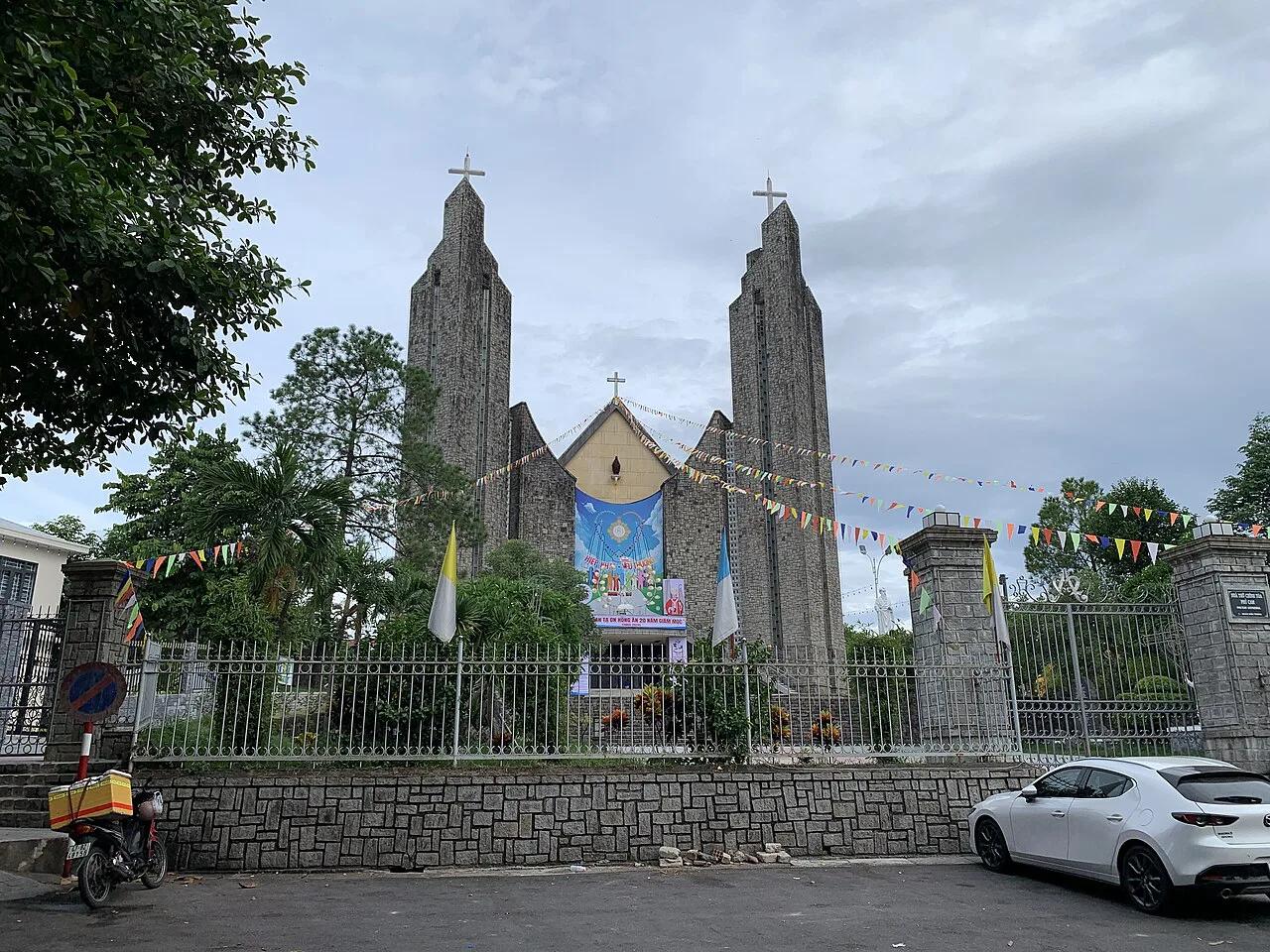
Start outside and look up. According to Vietnamnet, the symmetrical facade is framed by two bell towers rising 43.5 meters on either side of the central structure, the building is 80 meters long and 24 meters wide, and the plan is cruciform with a long central axis crossed by two wings. Those dimensions explain the silhouette from a distance: a broad, low mass topped by two slender towers.
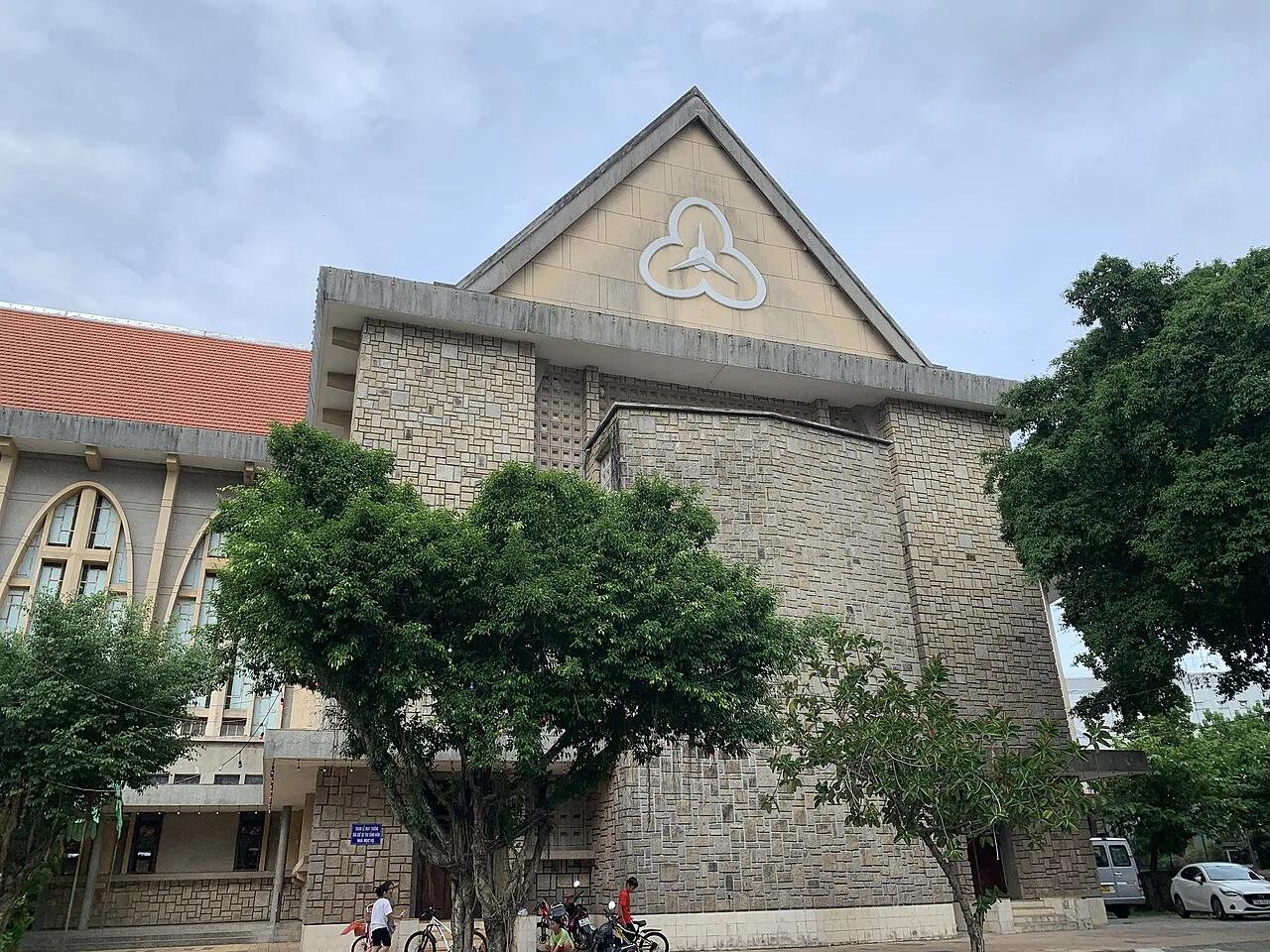
At ground level, pick out the sweeping stone curves that soften the entrance and the tall vertical strip of colored glass set into the center of the facade. The side elevations repeat tall arched windows with cross motifs above stone-clad walls, and a corridor of arches and deep eaves runs along the building to shade the interior from Hue's sun and wind-driven rain. Walk at least one side elevation, not just the front.
A third-party tour listing describes the facade as lit at dusk, but that is one visitor-facing account rather than a published schedule, so do not build an evening around it without confirming locally. Daylight is the safer bet for seeing the stone and glass as intended.
Inside the cathedral: pillars, vault and sanctuary
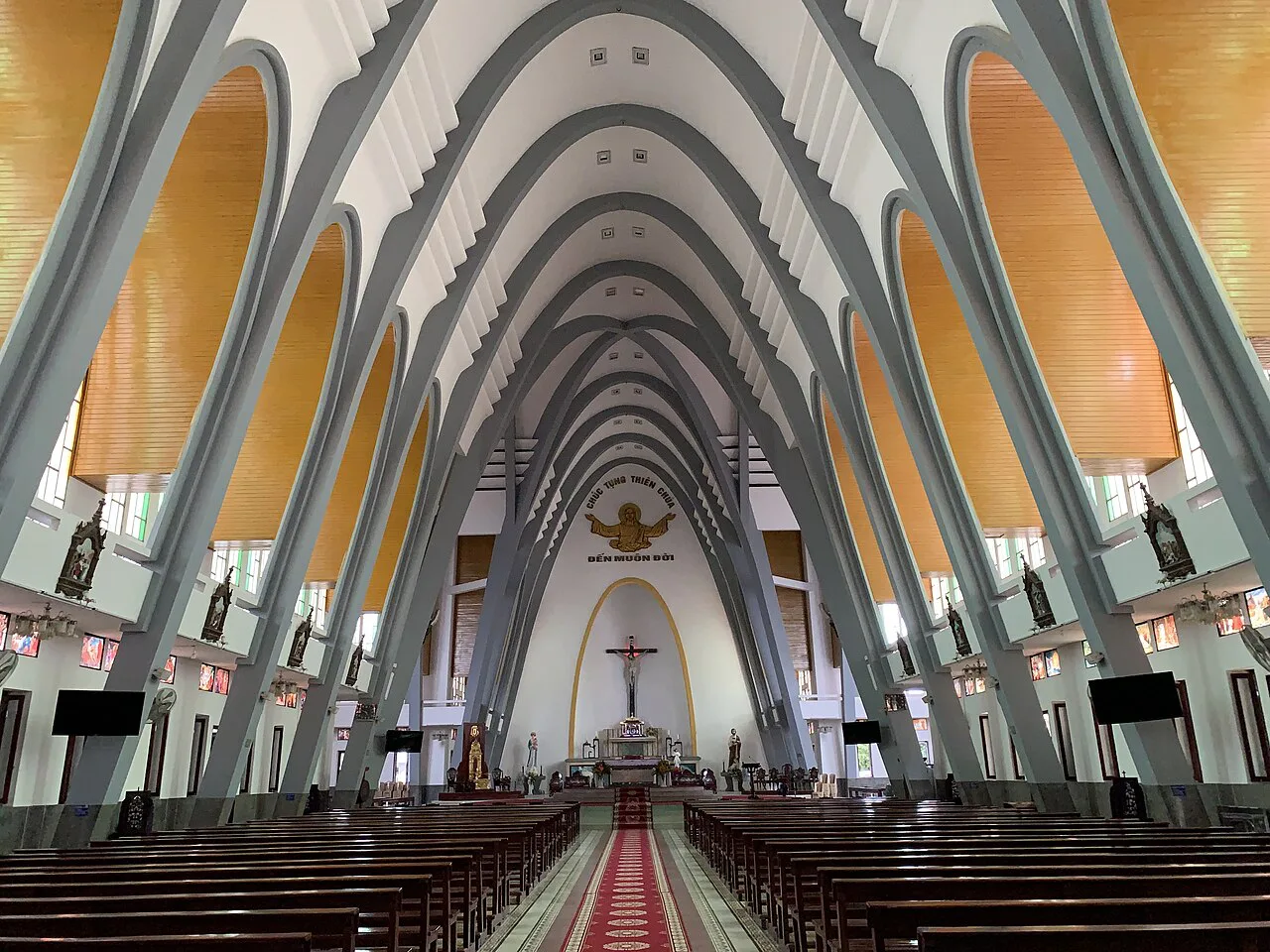
Inside, the reinforced-concrete pillars stand close to the walls and curve upward to meet as roof arches, a form often compared to hands pressed together in prayer. Vietnamnet reports that the vaulted structure rises to 21.5 meters and that the interior can accommodate around 2,500 people, which is why the space feels wide rather than merely tall. Look up along the length of the nave to see how the arches repeat toward the sanctuary.
The sanctuary sits at the crossing of the cruciform plan and is circular, approached by steps, with a main altar carved from a single block of marble on a raised platform near the recessed rear of the church. Tall arched windows combine blue glass with cross motifs, so the light shifts as the sun moves, and the walls carry wood-framed artworks depicting stages in the life of Jesus Christ.
Move slowly and quietly, and keep the central aisle clear during prayer. If a service is underway or beginning, do not walk the building as a sightseer; step to the back or wait outside until it ends. That single rule resolves most of the tension between a tourist stop and a working church.
Mass times and how to plan around services
Vietnam Catholic Tour lists Mass at Phu Cam as Monday to Saturday from 05:00 to 18:30, and Sunday at 05:30, 08:00, 15:00 and 18:30. Those are the only time figures the sources give, and they are a travel-site listing rather than an archdiocesan noticeboard, so treat them as a planning starting point. Confirm the current schedule with the Archdiocese of Hue or your hotel before you organize a day around a particular slot.
The Sunday morning slot changes the experience most: you will hear the congregation sing and see the church in use, but you lose the freedom to wander. If you want photographs of the empty interior, aim for a gap between services on a weekday morning rather than Sunday. Arriving early leaves you time to look outside before going in.
The published schedule is not an official opening-hours notice, so do not read it as a guarantee that the doors are open to visitors at every one of those times. If the church is closed for a private service, the surrounding southern Hue stops are reason enough for the trip. Confirm timings on the day, and check whether a feast day or holiday affects access.
Is there an entry ticket?
No source gathered here gives an admission fee for Phu Cam Cathedral, and there is no published ticket structure to plan around. Churches in Vietnam commonly admit visitors without charge while expecting respectful behavior, but do not assume a specific policy for this one. Ask at the entrance or check with the archdiocese if you need certainty.
The practical distinction is between visiting as a tourist and attending as a worshipper. A sightseeing stop is a short architectural visit outside service times; attending Mass means joining a congregation on its schedule and following its norms. Decide which you are doing before you arrive, because the two plans have different timings and expectations.

How much time to allow and when to come
For the building alone, 30 to 45 minutes is realistic: ten minutes walking the exterior and side elevation, then twenty to thirty inside looking at the vault, sanctuary, altar and windows. Add a further fifteen minutes if you want to watch light move through the blue glass, which is the detail most visitors rush past.
Midday heat in Hue is harsh on the exposed hillside approach, so a morning stop before the worst heat, or later afternoon, is more comfortable than noon. If you come for Sunday Mass, arrive ahead of the listed slot; if you come to photograph architecture, pick a weekday gap. There is no need to schedule a half-day for Phu Cam alone.
Etiquette on site
This is an active place of worship, so dress and behave as you would in a working church at home: shoulders and knees covered, hats off inside, phones silent, and no flash during prayer. Keep voices low and avoid photographing worshippers directly, particularly during the sacraments.
If a service is in progress, wait or return later rather than moving through the nave. Step aside for people arriving for prayer, do not block the aisle for a photo, and leave promptly when a service is about to begin. If you are unsure whether visitors are welcome at a given moment, ask the person at the door.
What to pair with Phu Cam on the same outing
The cathedral's southern-bank setting makes it a natural pairing with other south-of-the-river stops rather than with the Citadel across the water. A cycle or ride-hailing loop that takes in the cathedral and one southern sight uses the morning well without backtracking through traffic.
If you want a market stop on the same day, the Dong Ba Market in Hue sits on the north bank near the river, so pair it with a Citadel or riverside morning and cross to Phu Cam afterward. For imperial tombs further out, the Gia Long Tomb lies in the southern countryside and can be combined with a ride back into town, though it takes a bigger share of the day.
If your taste runs to royal architecture rather than religious modernism, the Hue Museum of Royal Fine Arts (Long An Palace) is a different kind of interior on the north bank and works better as its own stop. Keep the cathedral visit short and focused rather than trying to make it a full morning.
Is Phu Cam worth a stop on your Hue itinerary?
Yes, if you want one clear look at twentieth-century Vietnamese church architecture and are already spending time on the south bank. The 43.5-meter towers and the curving concrete vault make it a genuine landmark, and it costs you less than an hour of your day.
Skip it as a dedicated trip if you are short on time and focused on the Citadel and tombs; the cathedral rewards a passing stop, not a half-day. If you do go, confirm the current Mass schedule with the archdiocese or your hotel first, then time your arrival around a service rather than against it.