
Nha Trang Cathedral (Nhà thờ Núi): A Visitor's Guide

Nha Trang Cathedral is a free-to-enter Catholic church on a small hill at the Nga Sau intersection in central Nha Trang, and most visitors need only 15 to 20 minutes inside and around it. Locals call it Nhà thờ Núi, the Mountain Church, and you may also see it written as Nga Sau Church, Stone Church or Christ the King Cathedral, so don't be confused when a driver uses a different name. This guide covers where the church sits, how to reach the steps, the visiting windows and mass times reported by travel sources, what to look for inside, and how to fit it into a morning with one nearby sight.
What Nha Trang Cathedral is
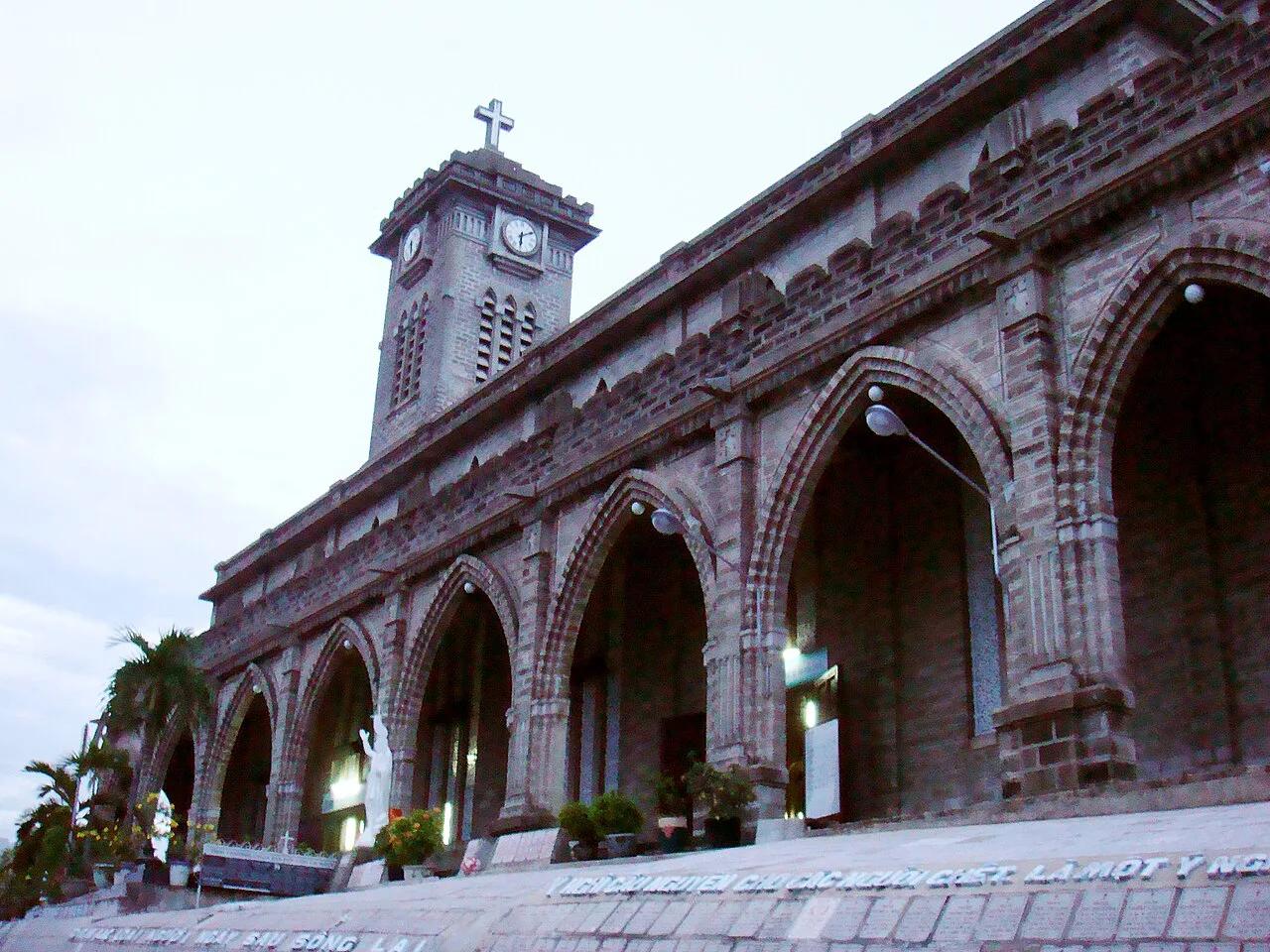
This is an active parish church, not a museum, built in a Gothic Revival style from small stone blocks and set on a rise that makes it visible from several blocks away. Its official name is Christ the King Cathedral, which is why guidebooks and signage vary so much. The gray stone exterior, arched windows and bell tower give it a European silhouette that stands out sharply against the surrounding Vietnamese cityscape.
Construction dates differ between sources: one travel guide puts the build between 1928 and 1935 under the French priest Louis Vallet, while another describes work carried out in stages from 1928 to 1933. The same guides disagree on the bell tower's height, citing either 28 or 38 meters, so treat any exact figure you read as approximate. What is not in dispute is the building's role: it serves as the seat of the Catholic Diocese of Nha Trang and remains a working place of worship for the local congregation.

Where it sits and how the approach works
The cathedral stands at 31 Thái Nguyên in the Phước Tân area of Nha Trang, Khánh Hòa, on a hill beside a multi-road intersection that locals know as Nga Sau. Because the church sits above street level, you reach it by climbing a short flight of stone stairs from the road; the top of the stairs doubles as a viewpoint over the surrounding streets. Allow a couple of minutes for the climb, and note that the steps are uneven in places, so wear shoes you can walk in rather than flip-flops if you plan to go up and down more than once.
If you are coming from farther out, a taxi or ride-hailing car can drop you near the base of the stairs rather than at the church gate, since the entrance is pedestrian-only. Ask the driver for Nha Tho Nui or Nga Sau Church, and confirm the fare in the app before you set off. From the main tourist quarter near the beach, the walk takes roughly 20 minutes at an easy pace, which makes this one of the few Nha Trang sights you can reasonably reach on foot without a ride.
Opening hours and mass times
Visiting hours and mass times are two separate schedules, and mixing them up is the most common reason people find the doors shut. According to Asia Legend Travel's guide, the church is open Monday to Saturday from 5:30 to 17:00 and on Sundays from 5:00 to 7:00 and 11:00 to 16:30, with weekday masses at 4:45 and 17:00 and Sunday masses at 5:00, 7:00, 9:30, 15:00, 16:30 and 18:30. Klook's destination page gives the same weekday and Sunday visiting windows, so the two sources agree on the broad shape of the day even if you should not rely on them to the minute.
A third source describes a slightly different pattern, saying you can see the exterior at any hour but usually get inside only during services, which it lists at 5:00 and 16:30 on weekdays and 5:00, 7:00 and 16:30 on Sundays. Given that these accounts diverge, plan your visit around a mid-morning or early-afternoon arrival, when you are most likely to find the courtyard open and the interior accessible between services. Confirm the current schedule through the parish's own channels or your hotel before making a special trip, especially on a Sunday or a feast day.
Tickets and how to avoid being charged
Entry to Nha Trang Cathedral is free, and no source in this guide describes an official ticket desk or admission fee. Watch for individuals or small groups outside who present themselves as staff and ask foreign visitors for money to go in; Asia Legend Travel warns specifically about groups charging up to VND 50,000 per person at a church that costs nothing to enter. If someone asks you to pay at the stairs, decline politely, walk up, and give nothing unless you are knowingly making a donation inside the church.
What to see inside and around the church
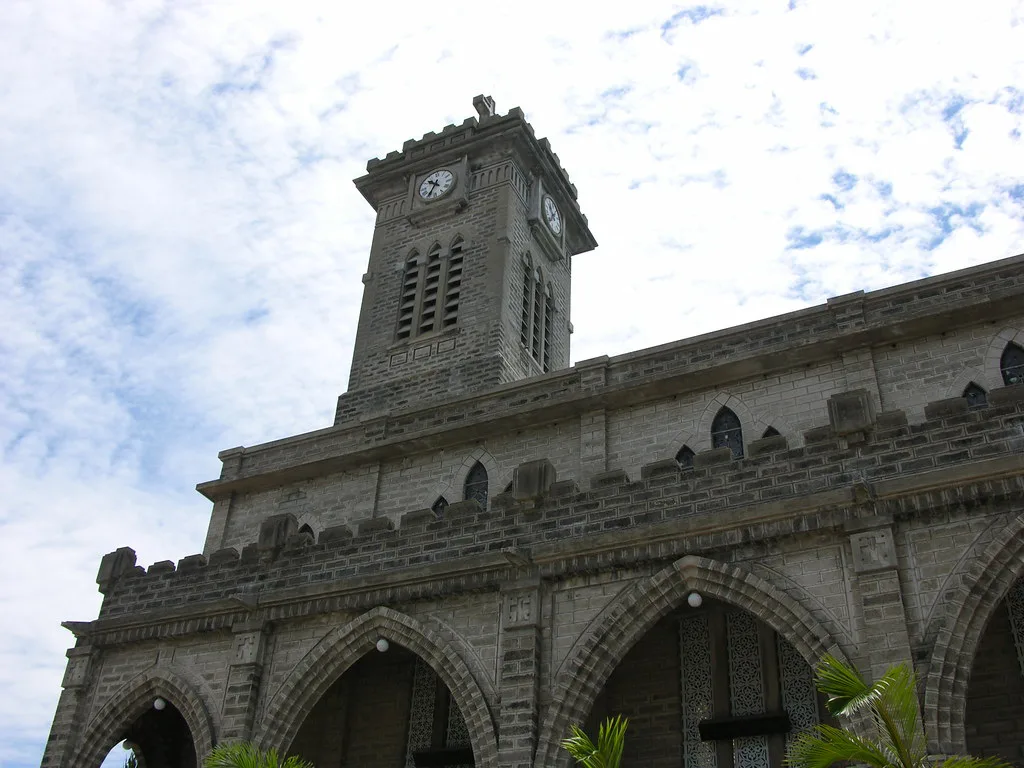
Start with the facade and the bell tower, which carries four large clocks facing different directions, reportedly made by the French bell foundry Bourdon Carillond, along with two bronze bells. The tower is the highest point of the building and gives the church its castle-like outline from a distance. Walk the perimeter courtyard next, where statues of Jesus and the Virgin Mary stand against the outer wall, and where a wall holds the ashes of the dead.
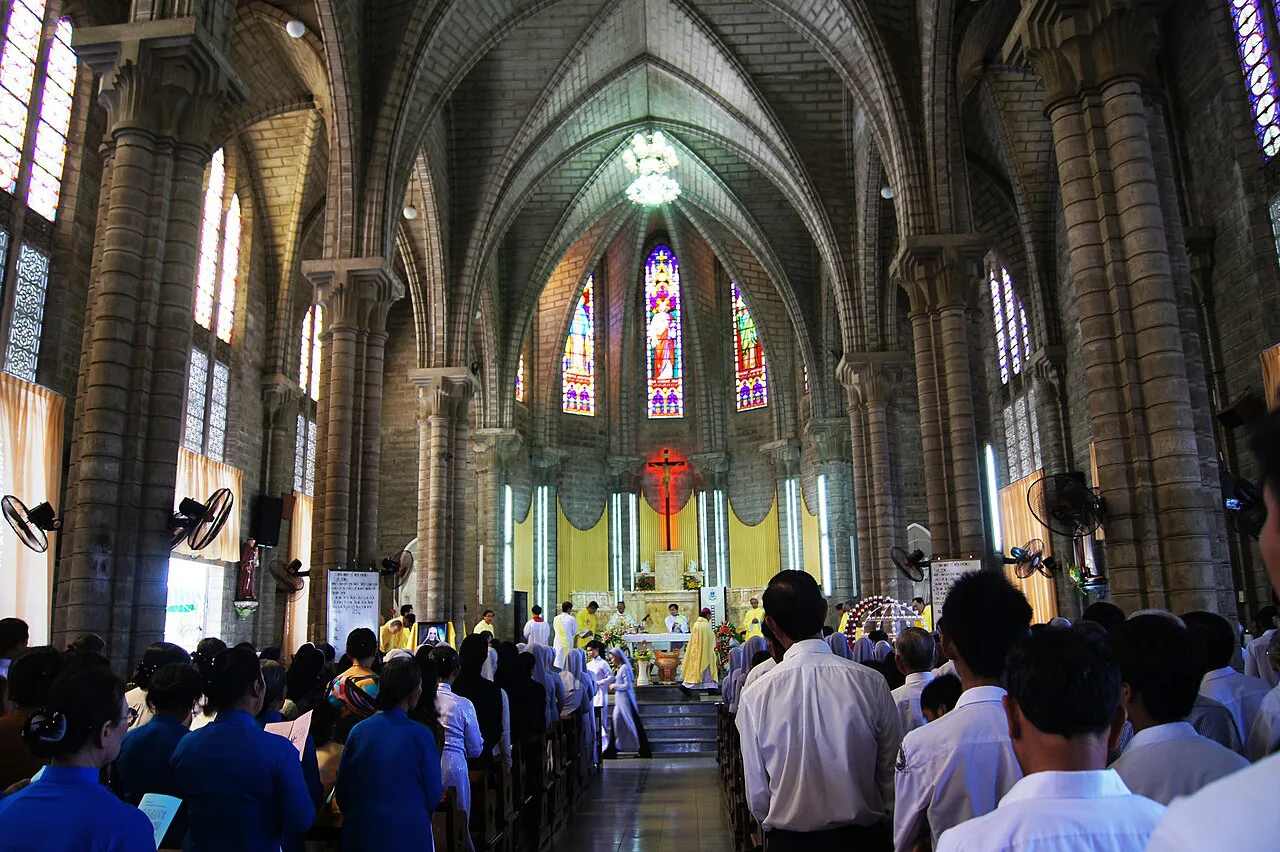
Inside, look for the Gothic vaulted ceiling, the rose-shaped stained-glass windows and the fourteen paintings of the Stations of the Cross that line the walls. The colored glass throws shifting light across the pews, especially in the early morning and late afternoon, which is one reason photographers favor those hours. A visitor's account notes that shoes come off at the door, a common practice at Vietnamese places of worship, so wear socks you don't mind being seen.
Etiquette as a working parish
This is a functioning Catholic parish, so dress modestly, meaning shoulders and knees covered for both men and women, and remove your shoes at the door if others are doing so. Keep voices low in the nave, and do not walk in front of people who are praying or photograph the congregation during a service. If a mass is underway, either sit quietly at the back or wait outside until it finishes rather than treating the aisle as a sightseeing route.
How much time to allow
Budget 15 to 20 minutes for the church, the courtyard and a few photos from the top of the steps, which matches the estimate given by one detailed travel guide. Add 20 to 30 minutes if you plan to attend a service, since you should arrive a little early and stay to the end rather than slipping out mid-mass. Sunset and early morning are the most comfortable times for the climb, but the visiting window closes by late afternoon, so don't count on an evening visit to the interior.
Nearby sights worth pairing with the church
Long Son Pagoda in Nha Trang is the natural pairing, since it lies in the same part of town and is easily combined with the cathedral in a single outing. The pagoda's hilltop white Buddha and the cathedral's gray Gothic tower give you two very different views of the city within one short ride. If you have a car or ride-hailing app, you can chain both with a stop along the beach road without much backtracking.
For a coastal change of pace, Hon Chong (Hòn Chồng) promontory to the north offers boulders and sea views a short ride away; check tide conditions before you plan around the rocks. If you prefer museums to scenery, the National Oceanographic Museum of Vietnam in Nha Trang and the Alexandre Yersin Museum in Nha Trang both sit within a reasonable taxi ride of the cathedral. For more ideas, our guide to the best things to do in Nha Trang lays out costs and a four-day plan you can slot this visit into.
Check the schedule, then climb the steps
Treat Nha Trang Cathedral as a short, free stop rather than a half-day destination: climb the stairs, walk the courtyard, spend 15 to 20 minutes inside, and skip paying anyone who asks for an entrance fee. Because sources differ on the exact visiting windows and mass times, confirm the current schedule through the parish or your hotel on the morning you plan to go, particularly if you want to attend a service. Pair it with Long Son Pagoda in Nha Trang for a natural half-day loop, and you will have seen one of the city's most recognizable landmarks without turning it into an all-day outing.