
National Oceanographic Museum of Vietnam in Nha Trang: What to See and How to Visit
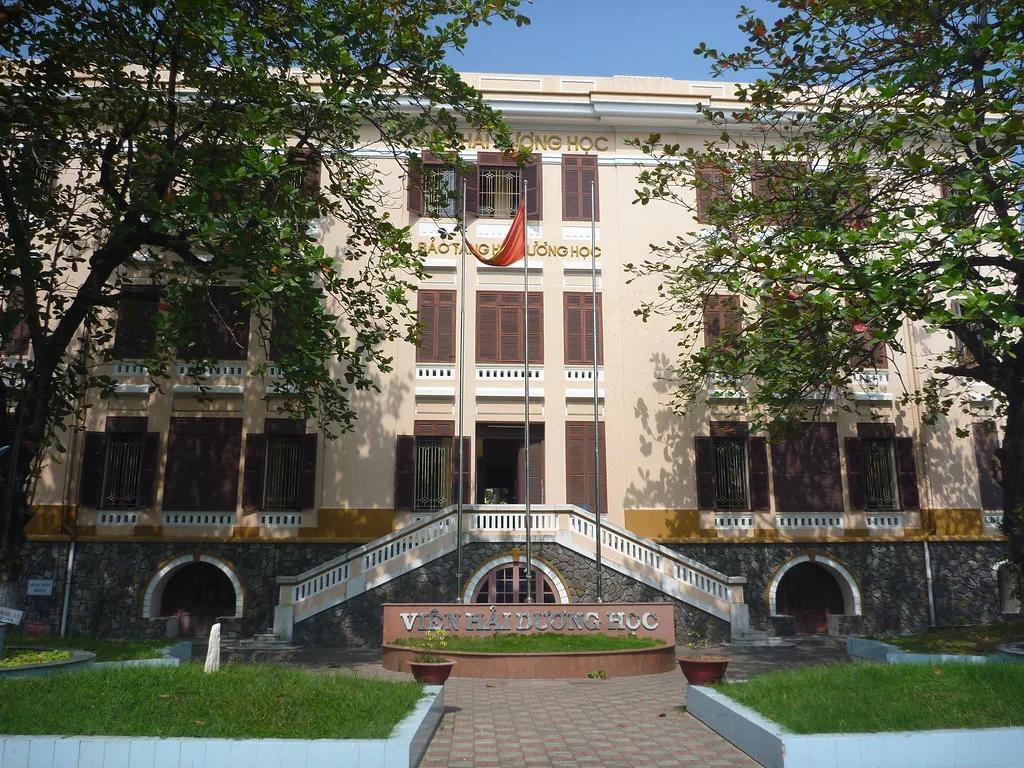
The National Oceanographic Museum of Vietnam (Bảo tàng Hải dương học) is worth about one to two hours of a Nha Trang trip, and it is the whale and dugong skeletons plus the live tanks that justify the ride out to Cau Da. It occupies a French-colonial building on the headland above Cau Da port, roughly 5 to 6 km south of the beach strip, and it is the public face of a working marine research institute rather than a stand-alone aquarium. This guide covers where the entrance is, how to reach it, what to prioritize inside, how long to allow, and which nearby sights pair with it.
One thing to settle before you go: the museum and the institute are the same address, so you are not choosing between two attractions. You are visiting the exhibition halls and tanks of the Nha Trang Institute of Oceanography, Vietnam's earliest scientific research facility, established in the 1920s according to VietnamNet. Read the ticket desk as the authority for the day's opening hours and adult admission in dong, because figures published in travel write-ups go stale.
What the museum actually is, and why it sits on Cau Da
The collection is large by any measure: the Vietnam News Agency describes holdings of about 23,000 specimens drawn from 5,000 marine species, which it calls the country's biggest assemblage of its kind. VietnamNet puts it at more than 20,000 specimens across over 5,000 types of sea creature, so treat the numbers as a scale indicator rather than a precise inventory you should count on seeing in one hall. What matters for planning is that this is a preserved-specimen collection first and an aquarium second.
The siting is deliberate. VietnamNet notes the institute was placed in Nha Trang because the city faces open international waters and sits near the deepest stretch of Vietnamese coastline, which is why the tanks and specimen jars are stocked with creatures from the Vietnamese sea and from Cambodian and Thai waters too. Walking through, that context is the point: you are looking at a research archive that happens to be open to the public, not an entertainment venue.
Where it is: 1 Cau Da, Vinh Nguyen ward
The address is 1 Cau Da, Vinh Nguyen ward, Nha Trang, Khanh Hoa province, on high ground beside Cau Da port. VietnamNet puts it about 6 km from the city center; other travel listings describe it as roughly 5 km, near the foot of the outcrop where Bao Dai Village was built. For planning purposes, treat it as a 15-to-25-minute ride from the central beach strip depending on traffic.
How to get there: taxis, ride-hailing and motorbikes
For most visitors, a metered taxi or a ride-hailing car is the simplest option, and a motorbike taxi is the cheapest if you are traveling alone and comfortable on two wheels. Agree the price or confirm the meter before you set off, and keep small notes ready for the return, because the museum is not on a street where you can count on hailing a car immediately. This is also where the practical case for asking the driver to wait becomes obvious.
Whichever mode you choose, go early. The heat on the exposed headland is the main comfort factor, the specimen halls are not strongly air-conditioned, and the outdoor areas are best before the middle of the day.
Opening hours and adult ticket price in dong
A VietnamNet report gave the museum's hours as 6 am to 6 pm on weekdays, with admission then at 40,000 VND for adults, 20,000 VND for students and 10,000 VND for children. Treat those figures as a historical baseline and a budget anchor rather than the rate you will pay now, since they are not recent. Ask at the ticket desk for the current adult rate in dong when you arrive.
The same report mentioned an outdoor sightseeing area running on a narrower window, from 9 am to 11 am, with boat trips to view sea life through a glass-bottomed hull or scuba diving to see the creatures. Treat the boat and dive add-ons as separately arranged activities rather than as part of your entry ticket, and confirm both availability and cost on site rather than assuming the pattern still holds.
Before you travel, confirm hours at the ticket desk, your hotel, or the institute's own published channel, particularly around public holidays when Vietnamese attractions often shift their schedules. The Vietnam News Agency video feature on the museum is a useful check on whether it is operating normally, though it is not a schedule.
What to see inside: specimens, tanks and the outdoor area
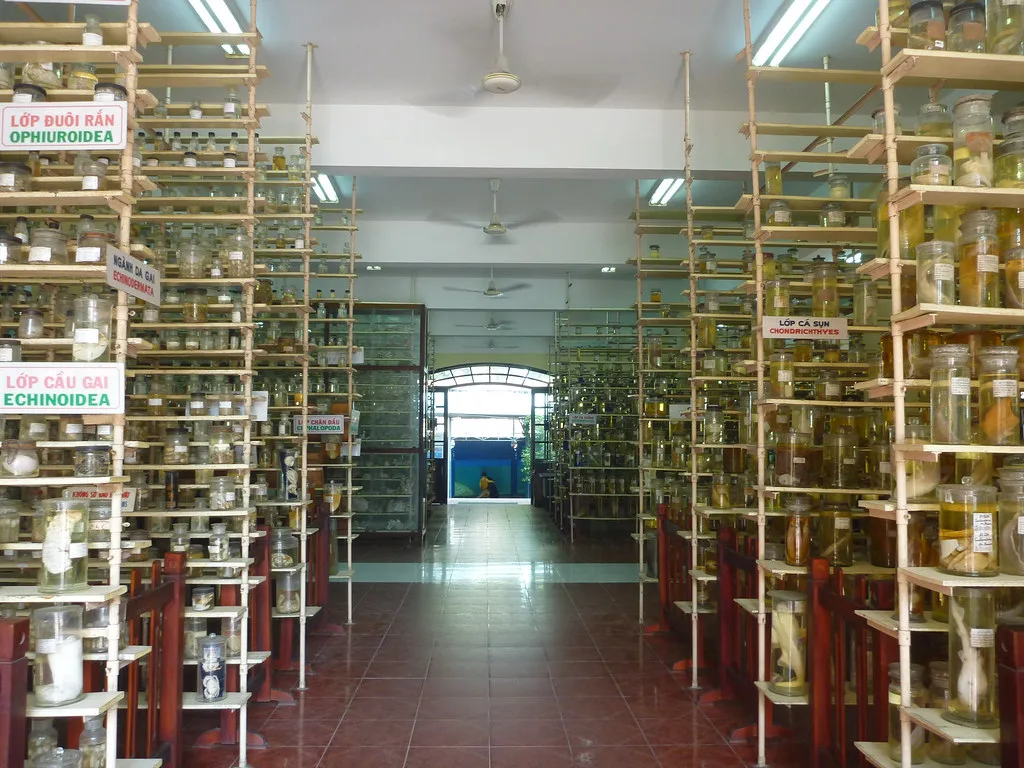
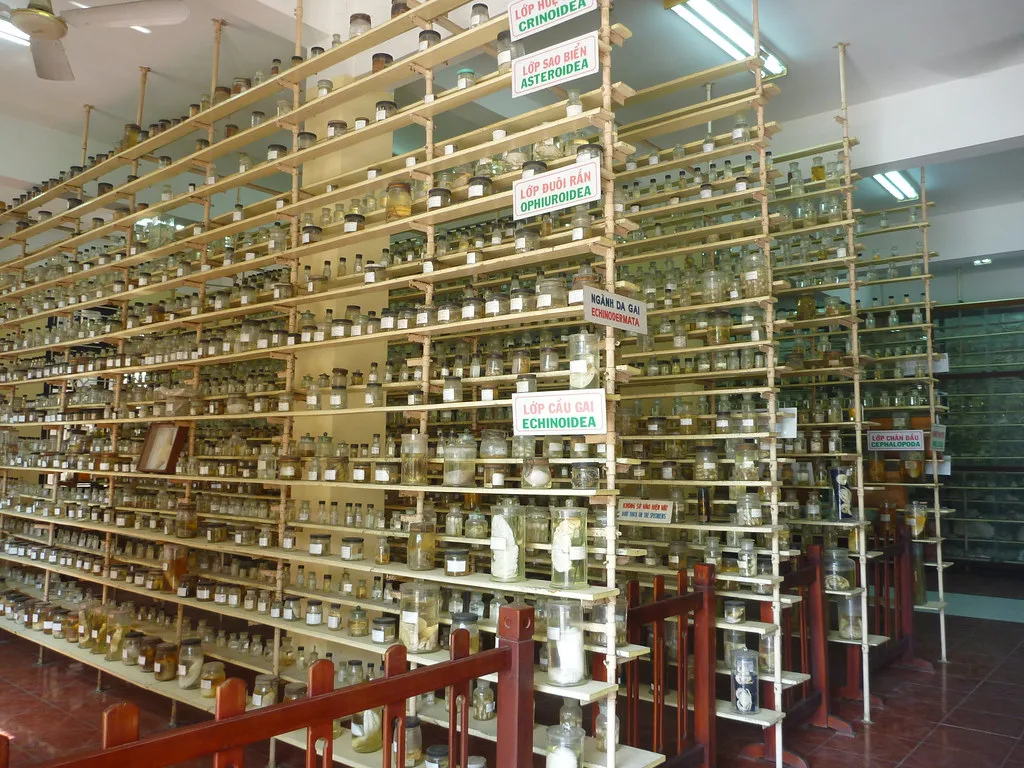
There are three distinct experiences in one compound, and knowing that helps you pace the visit. First, the specimen halls: rows of jars and preserved creatures dating back decades, which is where the research-institute character comes through. Second, the glass tanks holding live marine life. Third, the outdoor grounds, where the largest skeletons are displayed.
The preserved collection is the museum's strongest claim on your time. VietnamNet describes the holdings as spanning the Vietnamese ocean as well as Cambodian, Thai and neighboring waters, and notes that the Vietnam Book of Records Center recognized the museum in 2012 as holding the country's largest marine specimen collection. Labels are the reason to slow down: they tell you what you are looking at and where it came from, which is what separates this from a photo stop.
The headline skeletons: humpback whale and dugong
If you see only two things, make them the whale and the dugong. The Vietnam News Agency highlights an 18-metre humpback whale skeleton and a rare preserved dugong as the collection's showpieces. VietnamNet, less precise on size, lists the skeleton of a humpback whale, the skeleton of a "Nang hai" fish and the skeleton of an endangered sea cow, the dugong, among the museum's giant fossil skeletons.
How long to allow, families versus marine-life readers
For a family with young children, budget 45 minutes to an hour and plan on leaving while everyone is still interested. Lead with the whale skeleton and the live tanks, treat the specimen jars as a short walk-through rather than a reading exercise, and use the outdoor space to reset energy levels. The compact grounds make this easy to do.
Neither figure includes the glass-bottomed boat or diving add-ons, which need separate arrangement. This museum fits most naturally as a morning stop that leaves the afternoon free, which is worth weighing against the other things to do in Nha Trang before you lock in the day.
The French-colonial building and its 1920s origins
The building is part of the visit, not just a container for it. VietnamNet describes a grand French-colonial structure on a 20-hectare site above Cau Da port, established in 1923 and described as the leading marine research and archival facility in Vietnam and Southeast Asia. One travel listing records that it opened to the public on 14 September 1922, so the date you see quoted can vary by source; the point is the century-old institutional history, not the precise day.
Nearby options on the same trip
Cau Da sits on the same southern arc as Hon Chong (Hòn Chồng) Nha Trang, the granite headland with the hand-shaped rock formation, so it is sensible to pair the two in one ride rather than crossing town twice. Both are outdoor stops, so book them for the same morning and be realistic about the heat.
If you want a second indoor stop with a completely different subject, the Alexandre Yersin Museum in Nha Trang covers the career of the bacteriologist who worked in the city and is a natural counterpart to an ocean-science morning. In the center, Nha Trang Cathedral (Nhà thờ Núi) and Long Son Pagoda in Nha Trang are the standard heritage stops, both of which work better as a separate half-day than as an add-on to Cau Da.
Practical notes: heat, walking and confirming the current rules
Do not rely on a published price or closing time found in an old article. Confirm both at the ticket desk when you buy your entry, and if you are planning around a public holiday, check the institute's current channel the day before. Visitor reviews can tell you what the place felt like recently but are not a schedule.
Should the oceanography museum be on your Nha Trang list?
Yes, if you want a real collection rather than an entertainment attraction. The whale and dugong skeletons, the century-old specimen archive and the working-research setting make it the strongest indoor stop on the Cau Da side of the city, and one to two hours covers it well.
Skip it if your group wants interactive exhibits, big aquarium tanks and air-conditioned comfort, or if you are unwilling to make the ride south of the center. Otherwise, go early, combine it with one nearby headland or museum, and confirm the day's opening hours and adult ticket price in dong at the desk before you commit.
Sources
- Home to 23,000 specimens from 5,000 marine species, the Nha Trang Museum of Oceanography is Vietnam’s largest of its kind — a hub for conservation, exploration, and wonder. Highlights include an 18-metre humpback whale skeleton and a rare preserved dugong, offering a fascinating glimpse into the cou
- National Oceanographic Museum | www.holidayinvietnam.com
- A trip to Vietnam’s 100-year-old oceanography institute and museum
- Museums in Nha Trang